Lipreading Mom
The dark side of being a deaf extrovert is feeling cut off from people.
When I can’t hear conversations, I feel isolated – while everyone else mingles seamlessly, hears the nuances in a speaker’s voice, and catches the joke. I nod along, smile like everyone else, and pretend to hear the punchline.
I don’t want to ruin the pacing of every conversation, especially with strangers, by asking, “What was that? Could you please repeat that?” If I did that, a joke could take an hour for me to understand!
Helen Keller said, “Deafness cuts us off from people.”
If everyone knew how to communicate with those of us who can’t hear, wouldn’t that solve the isolation problem? Or, is the feeling of being cut off from people of my own doing because I am reluctant to ask “Could you please repeat that?”
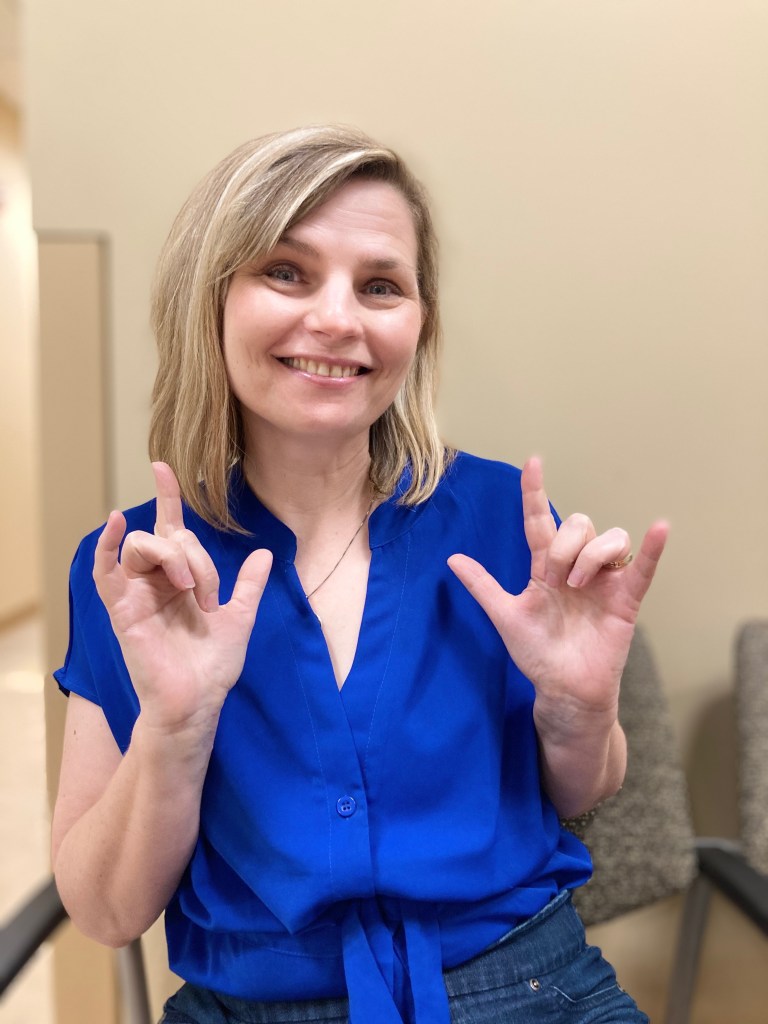
My close family and friends are familiar with my communication needs. I ask, “What was that? I didn’t catch that?” I study their faces as they speak, looking for visual cues as to the conversation context. I watch their mouths move as they talk because I am a lip reader.
As a child, I talked a lot. I considered myself an extrovert, always up for a good chat with anyone.
No one knew I had hearing loss back then, not even me, thanks to an audiologist’s misdiagnosis when I was six years old.
At school, I chatted away while the teacher presented a class lesson. A kindergarten teacher wrote on my report card: “Needs to nip that talking habit in the bud.” A second grade teacher wrote on the chalkboard the names of chatty students who talked out of turn with marks for each incident:
Mikey: X
David: X X
Shanna: X X X X X
Teachers typically stand more than six feet away from students and have their backs turned at the chalkboard. If I don’t see their faces and moving lips, I don’t know they are talking at all.
Sometimes as a child, I daydreamed or drew cartoon faces in a notebook instead of watching the teacher. This resulted in more marks next to my name for “not paying attention”.
Which leads to the dark side of hearing loss: Isolation becomes a coping mechanism. It is exhausting paying attention to an hour-long school lecture or a conversation in a room with background noise. I retreat into my quiet world with a good book or watch a captioned movie because it is easier than struggling with communication.
I’ve learned to advocate to avoid some of this isolation. When meeting friends for lunch or coffee, I ask to be seated at a quiet table. I ask family members to speak slower and with more articulation. I even ask them to repeat sentences.
A few years ago, I returned to school to become a special education teacher. For class lectures, I requested Communication Access Realtime Translation (CART), a professional transcription service. When professors lectured, I read their words with ease from a computer screen.
I taught special education classes for a public school district, and this is when my hearing issues posed enormous challenges. My classroom often was filled with background noise. I couldn’t decipher what coworkers and students said to me. I struggled with hearing questions, guiding class discussions, and listening to children calling out my name, “Miss Shanna!”
The stress and isolation I felt as a hard-of-hearing teacher worsened. I ultimately made the difficult decision to leave the teaching profession a few years ago.
In a perfect world, everyone’s voice would come with CART so that I could read their words when they spoke to me. Rooms would be quiet enough for me to hear conversations. In a perfect world, I would hear a joke’s punchline without asking for a repeat.
My hope is that having a cochlear implant will alleviate the stress and isolation and allow me to hear better. I really miss conversations.
 Lipreading Mom
Shanna, thank you for sharing! It’s so sad how misdiagnosis at an early age has impacted you throughout your life. Your posts make me more thoughtful as I interact with those with hearing loss, so I appreciate the insights. I’m excited to see the positive impact the cochlear implant has on your conversations as you adjust!
Thank you, Susan! I’m looking forward to us getting together soon.
Maybe you could share this with a teacher’s group or magazine so that educators are more aware. When they turn their backs to their students, some kids may not even know they are talking.
That is a good idea, RJ. When I was teaching, I had a few children in class who were deaf or hard of hearing. It was my goal never to turn my back and start speaking. Communication should be accessible to all.
I feel all of this. Even with cochlear implants, unfortunately. Because I think people assume the implants work like normal hearing. So even with the implants, you have to educate others and advocate for yourself. I don’t say that to discourage you; I think given that you have been a lip reader for so long, you will find the implant will make your life a lot easier. And while you still may not catch all the words being said, adding that tool to your lip-reading skills will be a life-changer.
I agree. Having lip reading skills can be very useful as so many of us with hearing loss or deafness are visual communicators: We often “listen” with our eyes.