September is D/deaf Awareness Month. It is an annual event to raise awareness about deafness and the Deaf culture.
In the United States, Deaf with a capital D represents the Deaf community, including those who use ASL as a primary language.
Lowercase deaf represents individuals who cannot hear and may use technology, including hearing aids and cochlear implants.
I identify as being deaf with a lowercase d.
I started life with hearing and gradually lost the sense of hearing over most of my life. The formal diagnosis is bilateral progressive sensorineural hearing loss, which means that the nerves in my cochlea, or inner ear, are damaged.
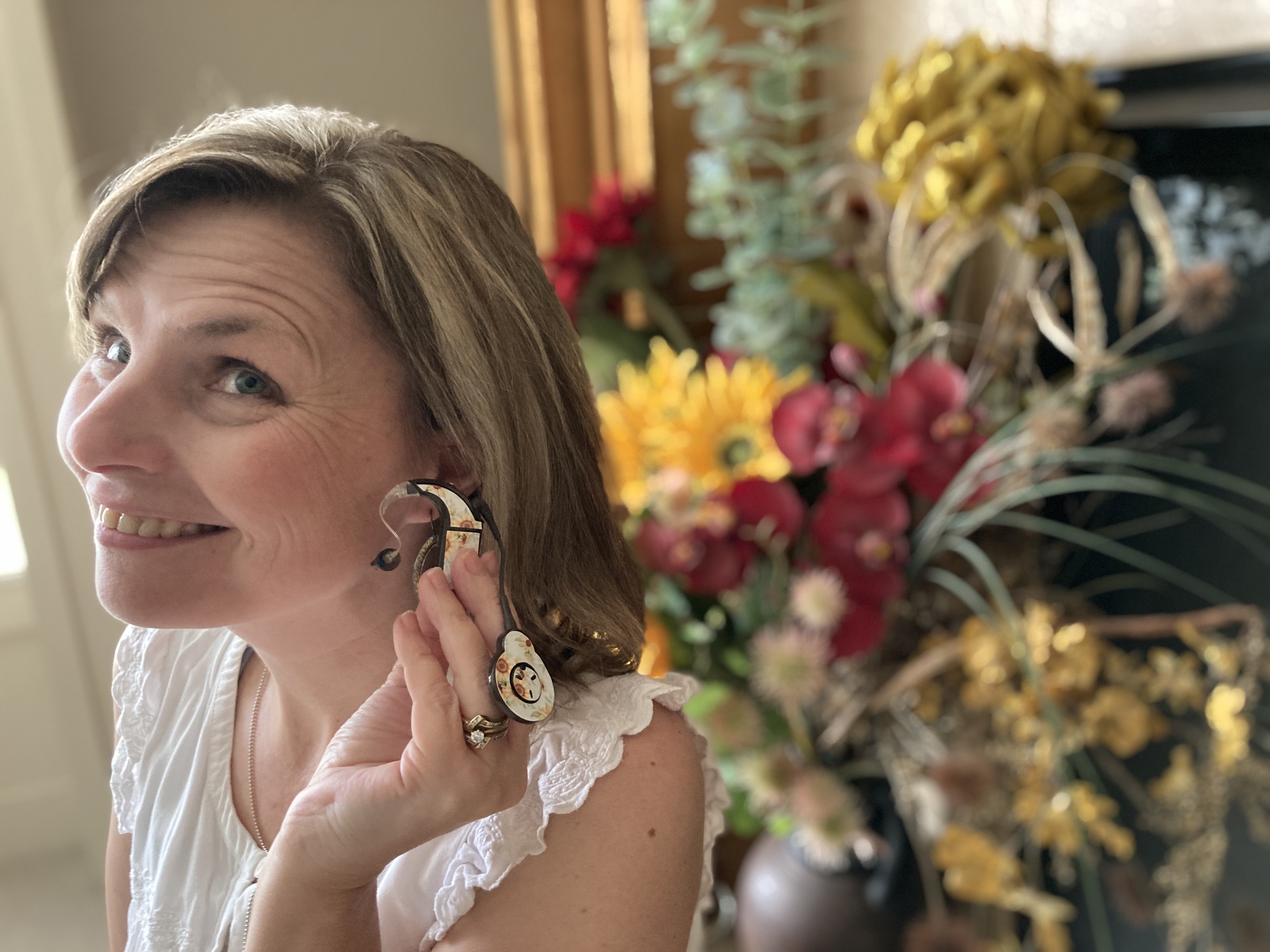
The cochlear implant in my left ear uses digital technology to input and process sound. It has an outer two-part processor device that is a round, magnetic coil that attaches to my head near my ear and a shell-shaped device with a microphone that rests behind my ear. It inputs the sounds around me through its tiny microphone on the top of the behind-the-ear processor.
The CI’s inner two-part device has an implanted sound receiver that connects with the magnetic coil and has an attached implanted wire that transmits sound to my cochlea. The implanted device stimulates my damaged auditory nerve system to transmit sounds to my brain, which interprets what I hear. I guess you could say that I’m wired for hearing. I hear digitally.
In the right ear, I wear a behind-the-ear hearing aid, which amplifies sounds that I can still hear acoustically.
In the photo I hold my cochlear implant, which is decorated with a sunflower pattern that matches the vase of sunflowers behind me. When I take off my CI, I am deaf, unable to hear sound in that ear. When I take out my hearing aid, I am deaf in that ear.
Please join me in raising awareness about D/deaf Awareness Month by amplifying the stories of people in the Deaf community and those who have profound hearing loss or deafness. Thank you for your advocacy and allyship. 🌻
 Lipreading Mom
Great info about upper case and lower case ‘Deaf.’ Writers need to be aware of this if one of our characters is deaf.
Thank you, RJ. Yes, variations of Deaf/deaf need distinction. Terminology that is not widely embraced in the D/deaf community is “hearing impaired” as it implies that a person is “impaired” and their hearing needs to be fixed. Deaf or deaf is not a bad word.