I recently met my friend, Rebecca, for tea and to talk about our mutual interest in writing. It was the first meet-up with a friend in a public place since the cochlear implant activation.
We chose a table with a seat facing a wall. Sound tends to bounce around and echo in noisy tea rooms and coffee shops, making for complicated listening. The wall acts as a noise buffer that allows me to focus on what my friend is saying.
Rebecca is a prolific writer, editor, and writing coach. Her latest book is about enduring and finding grace with life situations that don’t make sense. She brought a signed copy of the book, and her inscription gave me pause: “To one of the most resilient people I know.”
Merriam-Webster defines resilience as “capable of withstanding shock without permanent deformation or rupture.” The second definition is, “Tending to recover from or adjust easily to misfortune or change.”
The latter definition seems more relevant. Recovering from misfortune or adjusting to change is something to which many of us can relate. Progressive hearing loss and adult-onset deafness could fall into the category of “adjusting to change”.
The last time Rebecca and I met up was at Sunday service in a small local church a couple of years ago. I was a first-time guest and took visual cues from my friend. When I couldn’t hear announcements, prayers, or the sermon, I watched her reactions. When she bowed to pray, I bowed. When she stood to sing, I stood. When she opened her Bible, I grabbed my Bible. The one thing I could not imitate was hearing everything clearly.
Not long after that Sunday morning, I began noticing changes in my hearing. My left ear experienced a noticeable drop in hearing after a virus. I couldn’t understand conversations even with my best lipreading skills and in quiet environments. The number of get-togethers with friends became fewer because I couldn’t understand their words.
Going places without a hearing helper, usually my husband, caused enormous stress because I couldn’t understand what anyone was saying to me unless I had a helper repeat the words to me. I stayed home a lot. I became more of a hermit.
It was this stress and self-imposed isolation that helped me decide – I needed a cochlear implant to hear again, to engage again.
After the CI activation, my brain adapted to hearing sounds that weren’t audible before. I had additional CI mapping over the next few weeks that programmed more sound frequencies.
My get-together with Rebecca drinking tea and talking about writing was a milestone. I could hear and understand her in a noisy place. As a coffee grinder churned, I focused on Rebecca’s words. I appreciated her perspective about resilience. She called it “restoring what was lost”.
***
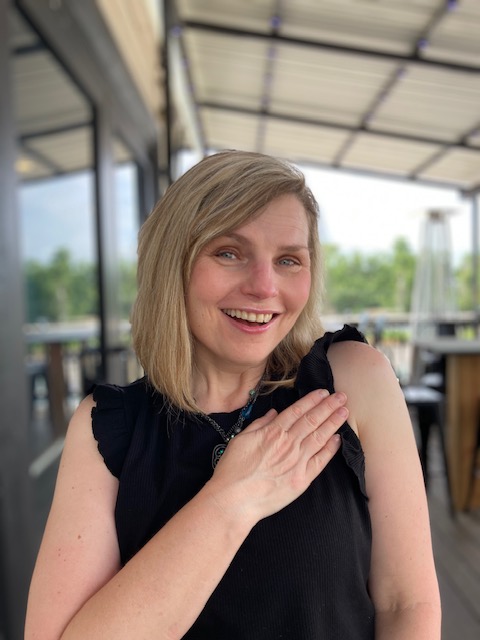
Photo description: Lipreading Mom places her hand over her heart and smiles.
 Lipreading Mom
I’m so glad I could be a part of your ‘maiden voyage’ into a public place after the CI activation. Always a pleasure to meet with you!
I am grateful for your friendship, RJ.
Hi Shanna! Sounds like you’re having good luck with your new CI activation. I was curious about music. How’s that coming across?
Hi Joe – Music accessibility is a work in progress, and it is greatly improved from the first week of CI activation. Each CI mapping allows me to hear sounds more “naturally”, including music.
Hi again Shanna,
Something’s not working with this comment feature. How I got the previous comment up there I’m not sure. It was out of pure frustration, I guess. I enjoy learning about your experiences with your new CI though.
Hi Shanna!
Was wondering how it’s determined what ear to implant? My thinking is the ear with less residual hearing. In my case my better ear was chosen. I wasn’t given a satisfactory answer so mine fell through. Long story short.
Joe – Thanks for asking. I had the ear that experienced the greatest loss implanted.