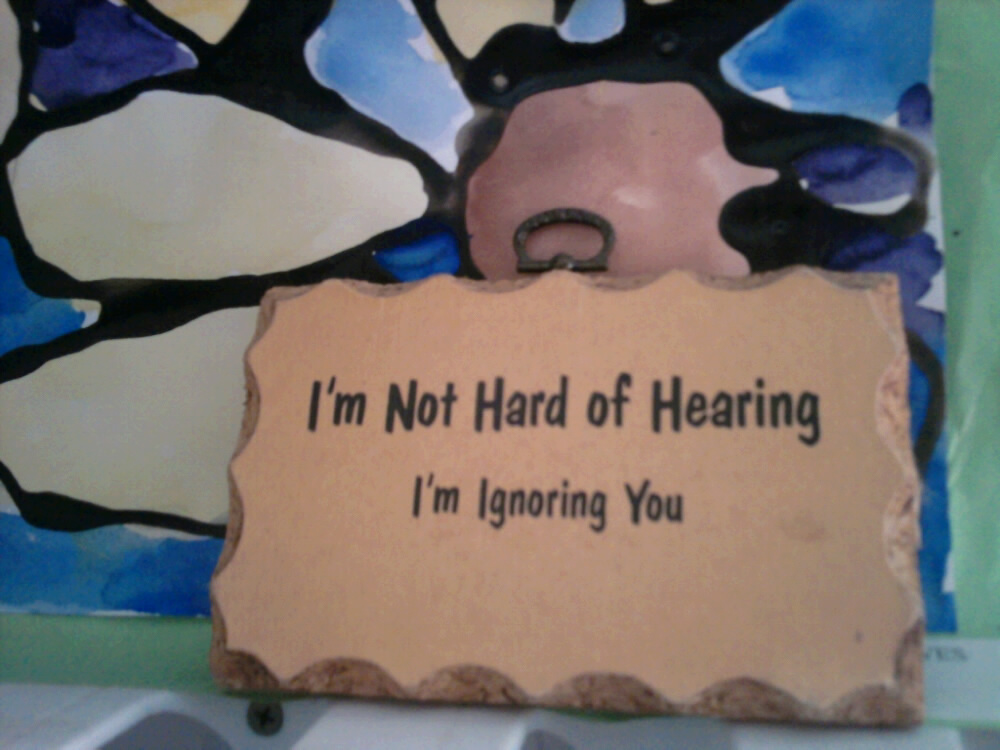
“I’m not hard of hearing. I’m ignoring you.” I love this sign that hangs at home. When it comes to rude comments, I’m finding it can be a good thing to pretend I didn’t hear. Or I can turn off my ears by taking out my hearing aids.
In all seriousness, I am wondering if you have experienced or witnessed something in your workplace or community known as a hearing loss microaggression. By definition, a microaggression is “a statement, action, or incident regarded as an instance of indirect, subtle, or unintentional discrimination against members of a marginalized group” (Oxford Dictionary). This would be situations in which friends, family, or work colleagues are aware of the hearing loss and continue to make comments that could be considered indirect, subtle, or unintentional discrimination.
In other words, they need to learn a little more about R-E-S-P-E-C-T.
Some of these examples are based on observation, stories others have shared, or the dreaded personal experience.
Someone’s colleague, acquaintance, or a complete stranger says:
- “Can you hear me? Are you understanding what I’m saying?”
- “I already said that. Are you listening?”
- Spoken slowly with exaggerated mouth movements: “Did. You. Get. That?”
This can also happen in the workplace:
- “I think he’s having a hard time following directions.”
- “Conference calls are hard for her. You might need to excuse her from attending them.” (Note: Most conference calls nowadays have access to closed captioning.)
- “We may need to put him on a work performance improvement plan due to this issue with not understanding directions.”
How do you handle these situations?
According to organizational psychologist Ella F. Washington in the Harvard Business Review article Recognizing and Responding to Microaggressions at Work, ask yourself these questions:
- What’s the right moment to say something?
- What’s your relationship to the individual who made the concerning comment?
- What’s your personal awareness of the microaggressions you experienced or witnessed?
Think about the right moment to address the concerning comment or behavior. It may be good to speak up in the moment if the concerning comment was said in a lighthearted way as a “joke”. Someone I know has shared this clever comeback to the guilty jokester: “I’ll forgive you for saying that if you’ll forgive me for laughing at you.”
For more serious infractions, you may need to address it privately in a one-on-one conversation or raise the issue with a supervisor. Some organizations allow you to report these concerns anonymously to an HR department.
The most important thing is realizing that the behavior says more about the other person than it does about you or me. And if this behavior is catching your attention, likely others also notice and share your concerns. Find a mentor or group that champions inclusion. This could be through a formal workplace mentorship program, an employee resource group, or colleagues and friends who support inclusive practices.
Do you have a “I just can’t get no respect” story of your own? How did you deal with the situation?
 Lipreading Mom
Years ago, I read a ‘Dear Abby’ column that addressed how to respond to rude comments. Abby suggested the phrase, “Why would you say something like that?” It forces the speaker to reconsider what they said and how to respond in the future.
Thanks for this post – a great reminder to all of us for how we should treat others.
RJ – I love the comeback phrase “Why would you say something like that?” as it calls attention to the reason for the comment. Thank you for sharing this insight.
I still deal with this a lot with my immediately family. Sometimes it comes to light that I was missing a crucial bit of information, and they will say, “you weren’t listening!”. Does it ever occur to you that I DID NOT HEAR YOU? I mean, cochlear implants are helpful but they certainly don’t solve all my hearing loss. Unless you were speaking directly to me, with my eyes on your lips and no outside or background noise, you can almost certainly guarantee I didn’t get the message. It’s a daily struggle.
I can definitely relate to having this happen with loved ones. That’s great how you advocate for yourself during these situations.
On a side note, I would like to learn more about your CI experience sometime.
Shanna, are you teaching lip reading classes either in person or online
or know someone who does preferably in Lawrence.
Hope you are doing well.
VIcki